

For owner-managers of growing South African SMEs, deciding how to extract profits from the business is one of the most critical structural choices you make. In the early days, money is often pulled out on an ad-hoc basis as cash flow allows. However, as your business gains traction and annual profits increase, informal drawings quickly become a source of tax inefficiency and unnecessary risk.
The core dilemma invariably boils down to two options: paying yourself a higher executive salary (PAYE) or taking returns as dividends. Balancing these two levers properly is not about searching for aggressive tax loopholes; it is about establishing a clean, compliant, and sustainable financial framework.
Here is an analysis of how salary and dividend extraction strategies operate under South African tax law, along with key guidance for owner-managers.
The Mechanics: Salary vs. Dividend
To determine the most efficient extraction path, it helps to review how each mechanism is treated by the South African Revenue Service (SARS).
1. Executive Salary (PAYE)
Salary is treated as an operational expense of the business.
- The Business Angle: Every Rand paid out as a legitimate executive salary reduces your company’s taxable income, directly lowering your Corporate Income Tax (CIT) liability calculated at 27%.
- The Personal Angle: Salary is subject to personal income tax (PAYE) on a sliding scale. Depending on your total annual earnings, your marginal tax rate can range from 18% up to 45%.
2. Dividends
A dividend is a distribution of profits to shareholders after corporate tax has been applied.
- The Business Angle: Dividends are not tax-deductible expenses – they are paid out of after-tax profits. The company must pay 27% CIT on its taxable profit first.
- The Personal Angle: When profits are declared as a dividend to a “human” shareholder, the company must withhold 20% Dividends Withholding Tax (DWT) and pay it over to SARS on the shareholder’s behalf. The remaining 80% is paid out tax-free to the individual.
- Structuring options: There is an option to structure your shareholding through another private company. This is called a “dividend shield”. When a South African company declares a dividend to another South African company, there is no DWT payable, i.e. you save the 20% DWT. Talk to us if you want to explore if this could work in your case.
Throughout this article we are assuming that you hold shares in your business in your personal capacity.
Comparing the Total Effective Tax Rates
A common misconception among business owners is that taking dividends is always cheaper because the 20% Dividends Tax rate is lower than their individual income tax bracket. However, because dividends are declared out of profits that have already been taxed at the corporate rate, you must consider the combined effective tax rate.
When you stack 27% Corporate Income Tax with the subsequent 20% Dividends Tax on the remainder, the effective tax rate on distributed corporate profits sits at 41.6%. This is equivalent to the effective tax rate of an individual that earns a salary of R5.32m per year (using 2027 tax rates).
How the Comparison Works in Practice
Here is the SARS tax table for individuals for 2027:
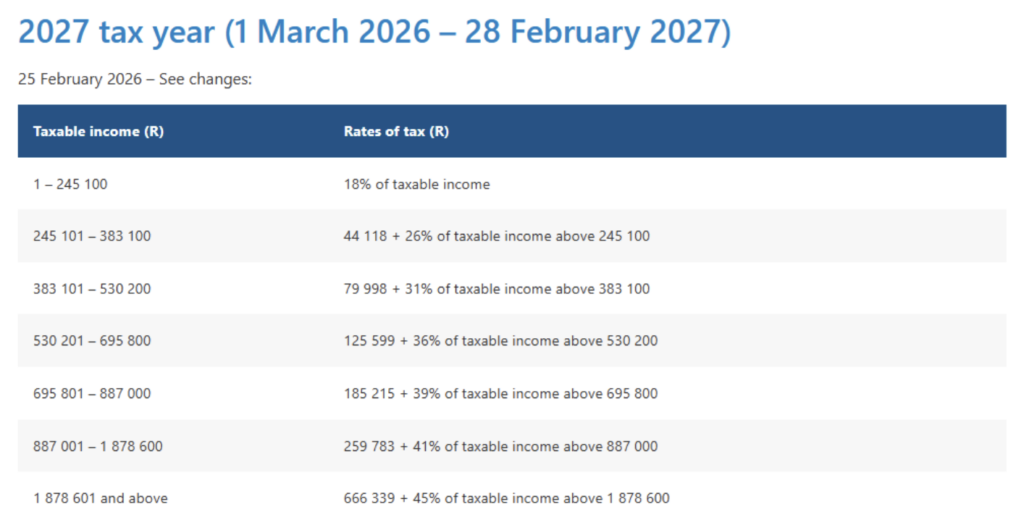
- If your salary is R870k per year, then your effective tax rate equals the company tax rate of 27%. A salary from R0 to R870k therefore saves more in company tax than you’ll pay PAYE. In this range you want to take a salary, not a dividend.
- If your personal taxable income is between R870k and R1.879m per year, you are still taxed at less than 41.6% for each additional Rand that you earn: Taking a market-related salary is generally more tax-efficient than declaring a dividend, as your effective tax rate moves between 27% (at R870k annual salary) to 34.52% (R1.879m annual salary). This is well below the 41.6% effective tax rate via the dividend route.
- If your personal taxable income exceeds R1.879m, then you are taxed at 45% for each additional Rand that you earn: A strategic mix of salary and dividends becomes relevant, because the total combined tax on dividends is capped at 41.6%, taking additional earnings above the top PAYE threshold as dividends saves you 3.4% compared to paying the maximum 45% personal income tax rate.
If you put a “dividend shield” company in place (mentioned above), then you can theoretically structure your affairs to never pay more than 27% tax.
Beyond the Numbers: Key Strategic Factors
Determining your remuneration strategy involves more than running a spreadsheet calculation. Several operational and regulatory factors should be evaluated:
1. The “Market-Related Salary” Principle
SARS expects active director-shareholders to be paid a reasonable, market-related salary for the day-to-day services they render to the company. Attempting to pay yourself a zero salary while relying entirely on dividends to avoid PAYE and Provisional Tax often triggers red flags during SARS verifications.
2. The CIPC Solvency and Liquidity Test
Under Section 46 of the Companies Act, a company cannot declare or pay a dividend unless the directors reasonably conclude that the business will satisfy the Solvency and Liquidity Test immediately after the distribution.
- Solvency: The company’s assets must exceed its liabilities.
- Liquidity: The company must be able to pay its debts as they become due in the ordinary course of business for the next 12 months.
Declaring dividends to extract cash when working capital is tight or liabilities outweigh assets is a contravention of company law that can expose directors to personal liability.
3. Personal Financial Health
While keeping your salary low on paper might seem appealing, it can limit your personal financial options outside the business. Banks and lenders assess personal mortgage or vehicle finance applications based on steady, verifiable income (formal pay slips and IRP5s) rather than irregular dividend declarations.
Finding the Right Path
There is no one-size-fits-all formula for extracting profit from an owner-managed SME. The most effective approach is typically a blended strategy:
- Establish a core salary: Set a regular, market-aligned salary that covers your personal living expenses, fits comfortably within lower personal tax brackets, and demonstrates clear substance to SARS.
- Review performance periodically: Assess your year-to-date profit margins, cash reserves, and upcoming capital requirements.
- Utilise dividends for surplus cash: Where surplus cash remains after servicing operational needs and maintaining working capital buffers, declare dividends to extract additional equity value.
By treating remuneration as a deliberate, structured framework rather than a monthly reaction, you maintain clean compliance, protect your cash flow, and ensure your financial structure continues to support long-term growth.